"We'd really like to post-insulate as effectively as possible," she said on the phone.
"I understand," I replied.
"Because that's what the government recommends too."
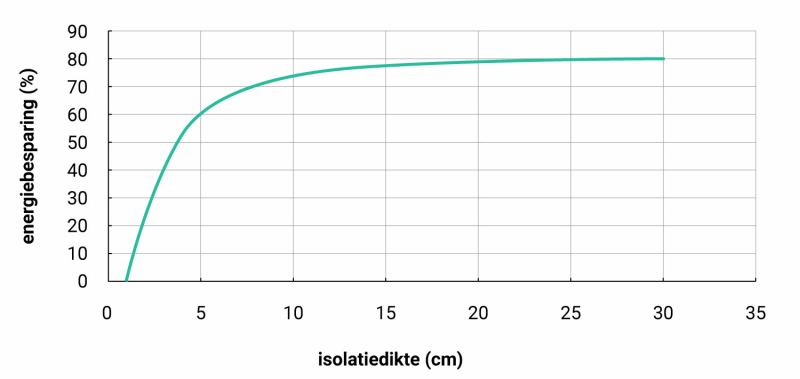
"But be aware that with the first 7 centimetres of insulation, you already save 60% energy, and after that, the curve flattens out."
There was silence on the other end of the line.
"And what about the other 40%?"
I then explained to her that you can also save a lot of energy by optimising what you already have in your home. From draught-proofing around doors and window frames to optimising your radiators. And also consider replacing single or double glazing older than 15 years.
"If you have 14 centimetres of ecological insulation installed, you'll achieve 75% energy savings and you can qualify for an ISDE subsidy"..."that's what I often do," I added.
Choose the right insulation thickness
If you're going to insulate your house, it's good to consider what insulation thickness you want and what fits in your house or office. You might have several considerations:
- You want the minimum insulation thickness to receive a subsidy.
- You want to achieve an energy label A with your insulation measures.
- You want to achieve insulation values that allow you to go off-grid for gas.
- You want insulation values to comply with building regulations.
Determine your insulation goal
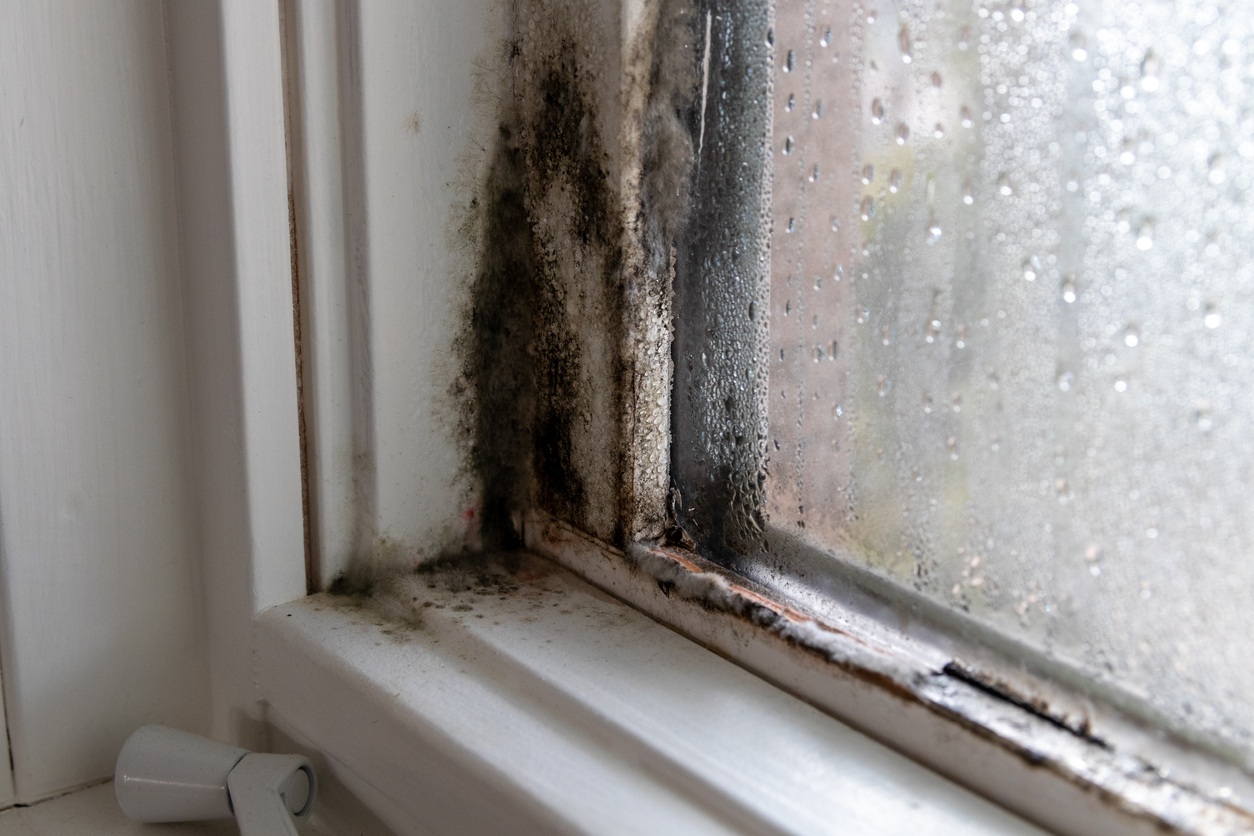
It's useful to determine the purpose of insulating your house in advance. It's also helpful to inventory whether you experience discomfort in your home due to, for example, draughts, cold, overheating, etc., and where in your house you experience this.
It's also useful to have a clear understanding of your heating needs. For example, do you (as discussed earlier in this book) want to keep a window open in the bedroom, like 90% of Dutch people? There's an extra tip on this in point 4 - Insulate only living areas - about thermal compartmentalisation and why it's cheaper.
Here are some possible goals you might have for insulating your house:
- Energy saving
- Increased comfort
- Reduced environmental impact
- Maintenance (keeping it habitable)
- Healthy indoor climate
- Or something else
Tip: insulation leads to lower energy consumption for heating, but the production of insulation materials also costs raw materials and energy.
Insulation requirements for new build and renovation
For new builds, extensions, or large-scale renovations, there are additional requirements for insulation values. A large-scale renovation means that more than 25% of the surface area of the building envelope is renewed, altered, or enlarged. The Rc-values below, in combination with other energy-saving measures, can result in an energy label A for your home or building.
The requirements for insulation values for new builds, extensions, and large-scale renovations are:
- Roof insulation must have a value of Rc ≥ 6.3 m2K/W. This corresponds to an insulation thickness of 24 cm of ecological insulation material.
- Floor insulation
Are slippers and indoor shoes a must-have in your home due to the cold floor? Floor insulation quickly provides a comfortable feeling. must have a value of Rc ≥ 3.7 m2K/W. This corresponds to an insulation thickness of 14 cm of ecological insulation material.
- Façade insulation must have a value of Rc ≥ 4.7 m2K/W. This corresponds to an insulation thickness of 18 cm of ecological insulation material.
If it's a minor renovation, the renovation guideline applies:
- Roof insulation must have a value of Rc ≥ 2.0 m2K/W. This corresponds to an insulation thickness of 8 cm of ecological insulation material.
- Floor insulation must have a value of Rc ≥ 2.5 m2K/W. This corresponds to an insulation thickness of 14 cm of ecological insulation material.
- Façade insulation must have a value of Rc ≥ 1.3 m2K/W. This corresponds to an insulation thickness of 18 cm of ecological insulation material.
The insulation requirements here are less stringent than for new builds. Examples of renovation include post-insulating a pitched roof against the sarking or under the tiles. For every renovation, the minimum Rc-value of 1.3 m2K/W must be met. If the currently present insulation has a higher insulation value, then this value serves as the lower limit.
Insulating and going off-grid for gas
Insulation is often a one-time job. So, even when post-insulating, consider a greater insulation thickness than required, to make it easier to go off-grid for gas in the future. Suppose you switch to a heat pump; you'll be in a good position if your house has an energy label A or B. If you have a lower energy label, it will require more power to heat your house with the lower heating temperature from an average heat pump.
If you want to achieve a passive house, you need to insulate very well. For this, a minimum Rc-value is often used as a rule of thumb.
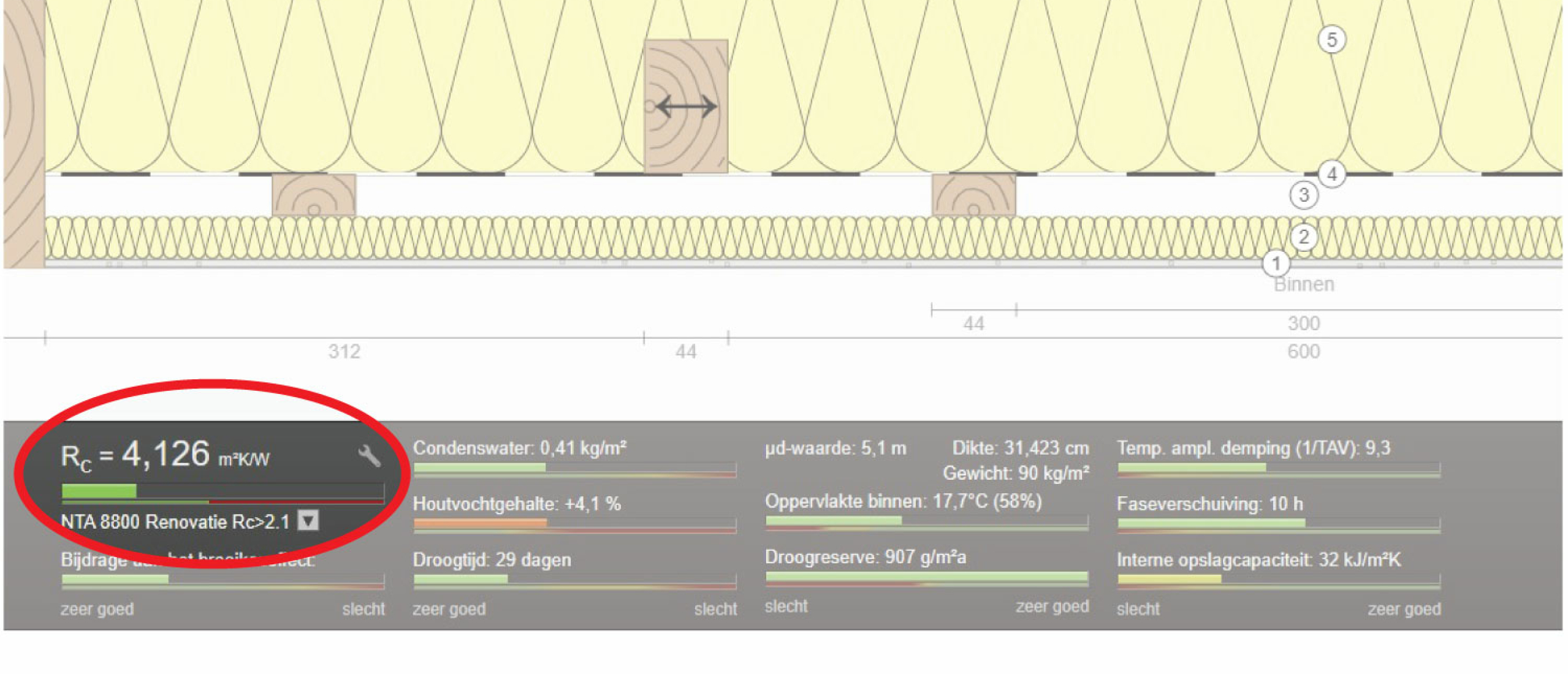
for floors, façades, and roofs of 8.0 m2W/K. This corresponds to an insulation thickness of 29 cm of ecological insulation material.
The first 7 centimetres of insulation yield the most
The first 7 cm of ecological insulation makes the largest energy-saving jump to as much as 60%. After that, the energy-saving jumps are much smaller (see the image below, where you see the curve flattening out). For example, with a doubling of the insulation thickness to 14cm, you achieve a total of 75% energy savings. That's a jump of 15%.
Subsidies and insulation values
To meet the national subsidy requirements for an ISDE subsidy from RVO, all insulation measures require a minimum Rd-value
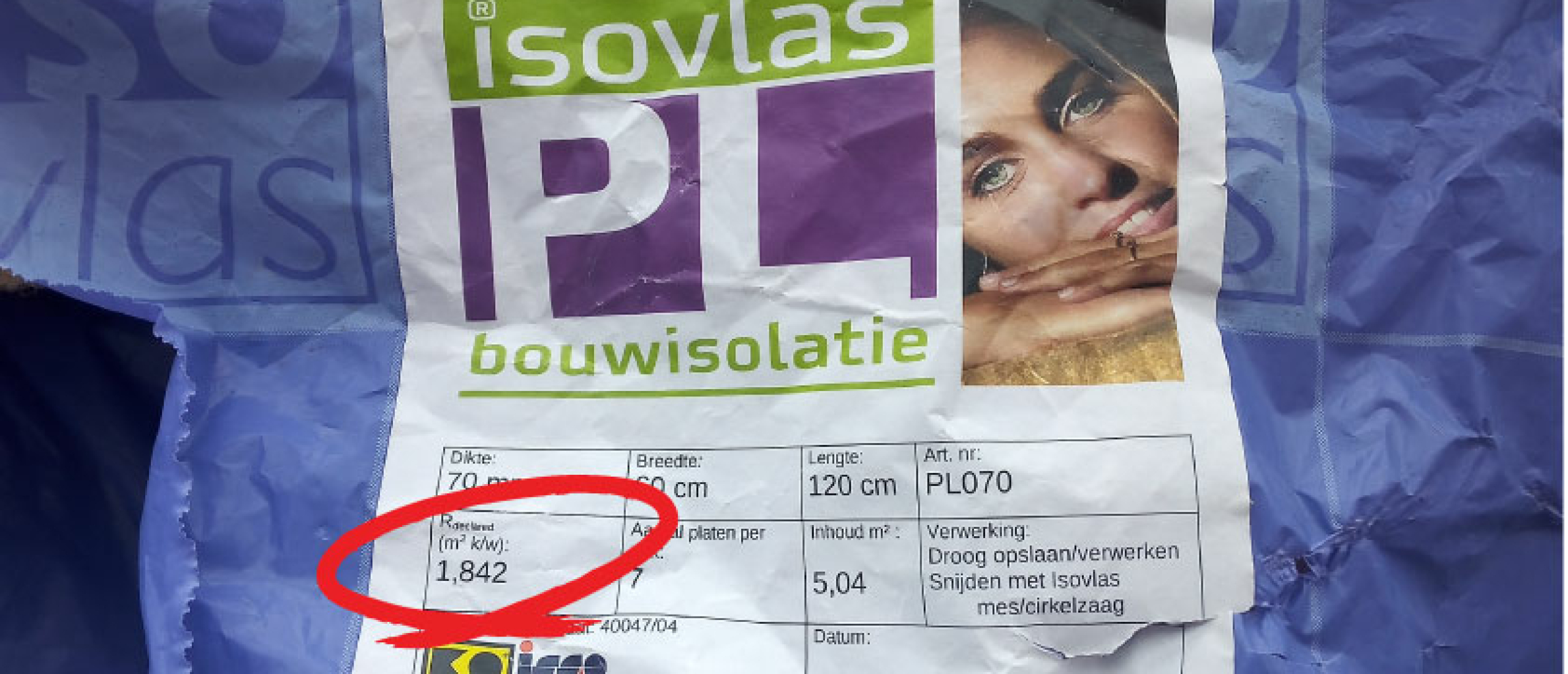
of 3.5 m2K/W, except for cavity wall insulation, which has a minimum Rd-value of 1.1 m2K/W.
Insulating with underfloor heating
If you have underfloor heating or are considering getting it, Milieucentraal recommends aiming for an Rc ≥ 5 m2K/W for your floor. For a wooden floor with wooden beams every 60 cm, this corresponds to an insulation thickness of 24 cm of ecological insulation material. In practice, there are known cases where floor insulation with an Rd of around 3.5 m2K/W and underfloor heating also saves a lot of energy.
Phase shift
With ecological insulation materials,
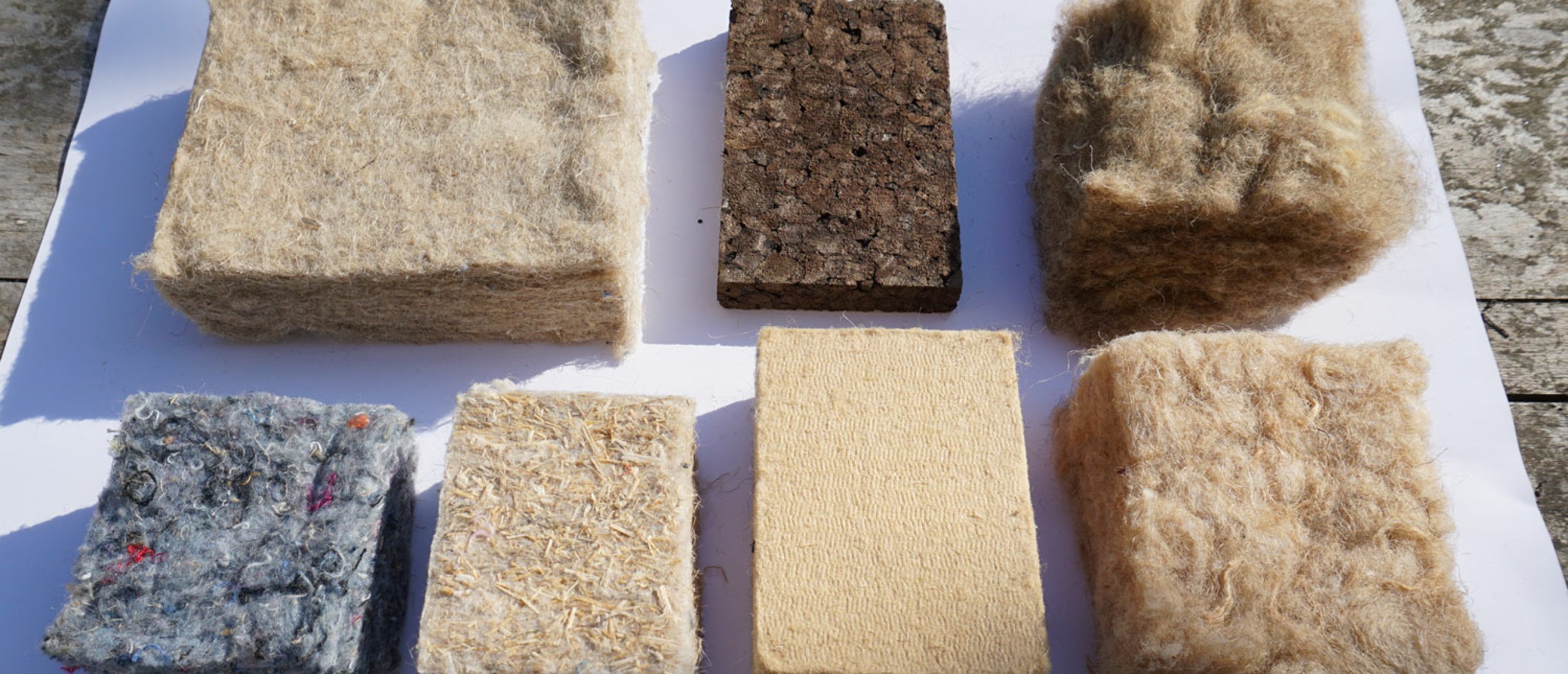
it takes longer for summer heat to penetrate your home. This is called phase shift. Ideally, you want a phase shift

The phase shift indicates how long heat takes to pass through a material. Phase shift is the time between the peak outdoor heat and the peak indoor heat, expressed in hours. This value is among others... of 8 - 12 hours. That is the time it takes from the hottest part of the day until sometime in the night. Too great a phase shift is also not beneficial, as the heat might only penetrate your house when it can no longer cool down due to renewed heat during the day.
Register energy performance?
If you wish to officially register the energy performance of your building, for example, because you are obliged to have an energy label C for your business premises
in 2023? Then it is wise to choose insulation measures that are listed in the bcrg.database. Isovlas flax insulation is currently the only ecological insulation material in this database. It is generally expected that the other ecological insulation materials will also be included in such databases within the foreseeable future.