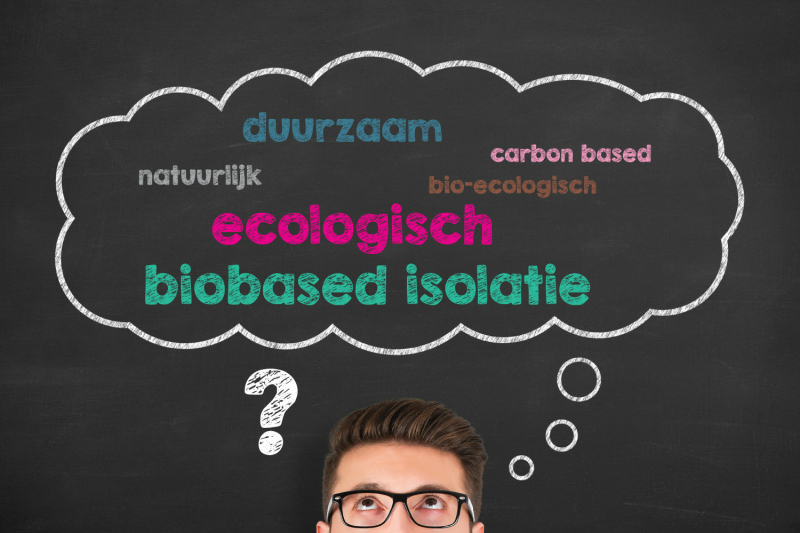
What is biobased insulation?
...and what is the difference between it and ecological or natural insulation?
- 🌲 The term 'biobased' has been widely used in recent decades by pioneers to indicate that the (insulation) material is made from naturally grown raw materials.
- 👨💻 Government officials have massively adopted the term 'biobased'.
- ⏲ The term 'ecological insulation' has been in use for a longer time.
- However, there are companies that believe they can also claim the term 'ecological' because their synthetic insulation, for example, requires little transport volume 🚚.
- ⚖️ That is why the term 'biobased' is often used to make a clear distinction.
WHY THIS IS IMPORTANT:
During the production of mineral and synthetic insulation, a lot of CO2 is emitted 🏭. The construction sector can make a huge contribution to curbing climate change by becoming CO2 positive. This can be achieved with the help of natural insulation materials that absorb 'biogenic' CO2 🌫️. In this way, CO2 from the air is converted into C (carbon, or biomass, and in this case, insulation materials🏡) and O2 (oxygen💨).
WHAT WE SEE:
🔎 The search volume on Google for 'biobased insulation' is currently: 140 - 210 per month 📈; 'ecological insulation': 90 - 110; 'natural insulation': 70 - 110; 'sustainable insulation': 170 - 210
BETWEEN THE LINES:
'Biobased' is still a relatively new term for many people.
- We still hear our potential customers rarely use the term 'biobased'.
- The terms 'ecological' and 'natural' are currently used much more frequently.
- Perhaps the higher search volume is because many people don't yet fully understand what 'biobased insulation' means but are hearing the term more often?
THE BOTTOM LINE:
In any case, let's help those interested in 'biobased', 'ecological', and 'natural' insulation make the right choice when it comes to insulation.