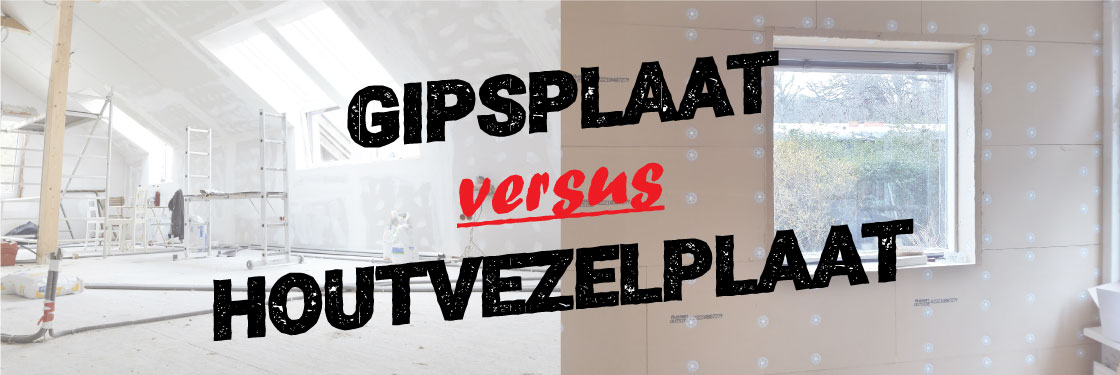
Gypsum plasterboard vs. wood fibre board
When insulating your home, you will eventually have to choose a finishing material. Often, you'll want to achieve a smooth finish that you can paint, wallpaper, or plaster. The two most common choices for this are gypsum plasterboard and wood fibre board. In this article, we, Isoleerbewust, explain the differences between these two materials.
Advantages and disadvantages of gypsum plasterboard
Gypsum plasterboard is a well-known material in the construction industry. It has been used for decades as a finishing material for walls and ceilings. This is not without reason, as gypsum plasterboard offers several advantages.
Advantages of gypsum plasterboard:
- Low cost: Gypsum plasterboard is generally cheaper than wood fibre board, making it an attractive option for budgets.
- Easy to install: Gypsum plasterboard is relatively easy to cut and install, which can save time and labour costs.
- Fire-resistant: Gypsum plasterboard has good fire-resistant properties, which contributes to the safety of your home.
- Smooth finish: Gypsum plasterboard provides a smooth and even surface, ideal for painting, wallpapering, or plastering.
Disadvantages of gypsum plasterboard:
- Less impact-resistant: Gypsum plasterboard is more fragile than wood fibre board and can be damaged more easily by impacts.
- Moisture-sensitive: Gypsum plasterboard is less suitable for damp areas unless specially treated with a moisture-resistant coating (green plasterboard).
- No insulation value: Standard gypsum plasterboard offers almost no insulation value, meaning you need to provide additional insulation material.
Advantages and disadvantages of wood fibre board
Wood fibre board, also known as softboard or natural insulation board, is a more environmentally friendly alternative to gypsum plasterboard. It is made from compressed wood fibres.
Advantages of wood fibre board:
- Good insulation value: Wood fibre board offers excellent thermal and acoustic insulation. This keeps your home warmer in winter and cooler in summer, and it also reduces noise pollution. What's more, subsidies are often available for insulation, and wood fibre board counts as insulation material.
- Breathable: Wood fibre board is a breathable material that contributes to a healthy indoor climate by regulating moisture.
- Environmentally friendly: Made from renewable raw materials, wood fibre board is a sustainable choice.
- Impact-resistant: Wood fibre board is more robust than gypsum plasterboard and offers better resistance to impacts and damage.
- Good for acoustics: Wood fibre board is often used to improve acoustics, particularly in spaces where sound needs to be damped.
Disadvantages of wood fibre board:
- Higher cost: Wood fibre board is generally more expensive than gypsum plasterboard.
- Heavier: Wood fibre boards are often heavier than plasterboards, making installation a bit more physical.
- Less fire-resistant: Although wood fibre board has some fire-resistant properties, it is generally less fire-resistant than gypsum plasterboard.
Conclusion: Gypsum plasterboard or wood fibre board?
The choice between gypsum plasterboard and wood fibre board depends on your specific needs and priorities. If budget is your main concern and you are looking for a simple finish, gypsum plasterboard is a good choice. However, if you are looking for additional insulation, a healthy indoor climate, and an environmentally friendly solution, then wood fibre board is a better option. Although wood fibre board is more expensive, you may be eligible for subsidies for installing insulation, which can make the investment more attractive.
At Isoleerbewust, we are happy to advise you on the best choice for your situation. Please feel free to contact us for personal advice.