Why so many people are mistaken about insulation
If you search for ‘insulation payback period’, ‘how quickly will my insulation pay for itself’ or ‘is insulation profitable’, you'll find the same message almost everywhere. Insulation is said to pay for itself within a few years, making it one of the smartest investments for your home.
In practice, it's more nuanced. Insulation can certainly be profitable, but the outcome varies greatly per home. Yet, these differences are rarely mentioned. This creates expectations that do not always align with reality. That is precisely why some homeowners are disappointed after an insulation measure, even though the execution was technically sound.
Have you ever considered the payback period for a new kitchen, bathroom, or car?
What is the true payback period for insulation?
Most calculations for insulation costs and savings are based on a fairly simple formula. You invest a certain amount, divide that by an estimated annual saving, and thus arrive at a payback period of, for example, six to seven years.
This calculation seems logical but is based on assumptions that often do not hold true in practice. For example, it accounts for ideal conditions, constant energy prices, and a home that behaves predictably. It also assumes that the execution is perfect and that residents do not adjust their behaviour.
In reality, all these factors play a significant role. As a result, the actual savings can deviate considerably from what was calculated in advance.
Research on payback period
Research by I&O Research in 2021 shows that households often have an incorrect perception of how quickly insulation measures pay for themselves. Some solutions are estimated too optimistically, while others yield a return faster than expected.
For example, many people think that cavity wall insulation and loft floor insulation only pay back after more than five years. In reality, that payback period is around three years. On the other hand, HR++ glass is often overestimated: although people expect this investment to pay for itself quickly, in practice it takes an average of about ten years.
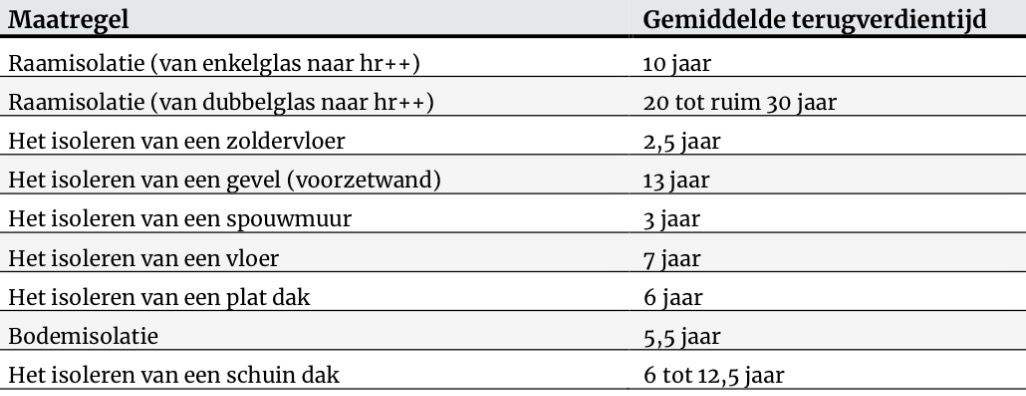
Table from the research by I&O Research on, among other things, insulation payback period.
Why insulation is not a simple calculation
An important principle often overlooked is that insulation has diminishing returns. The first measures usually yield the greatest gains. After that, the effect of each additional measure decreases.
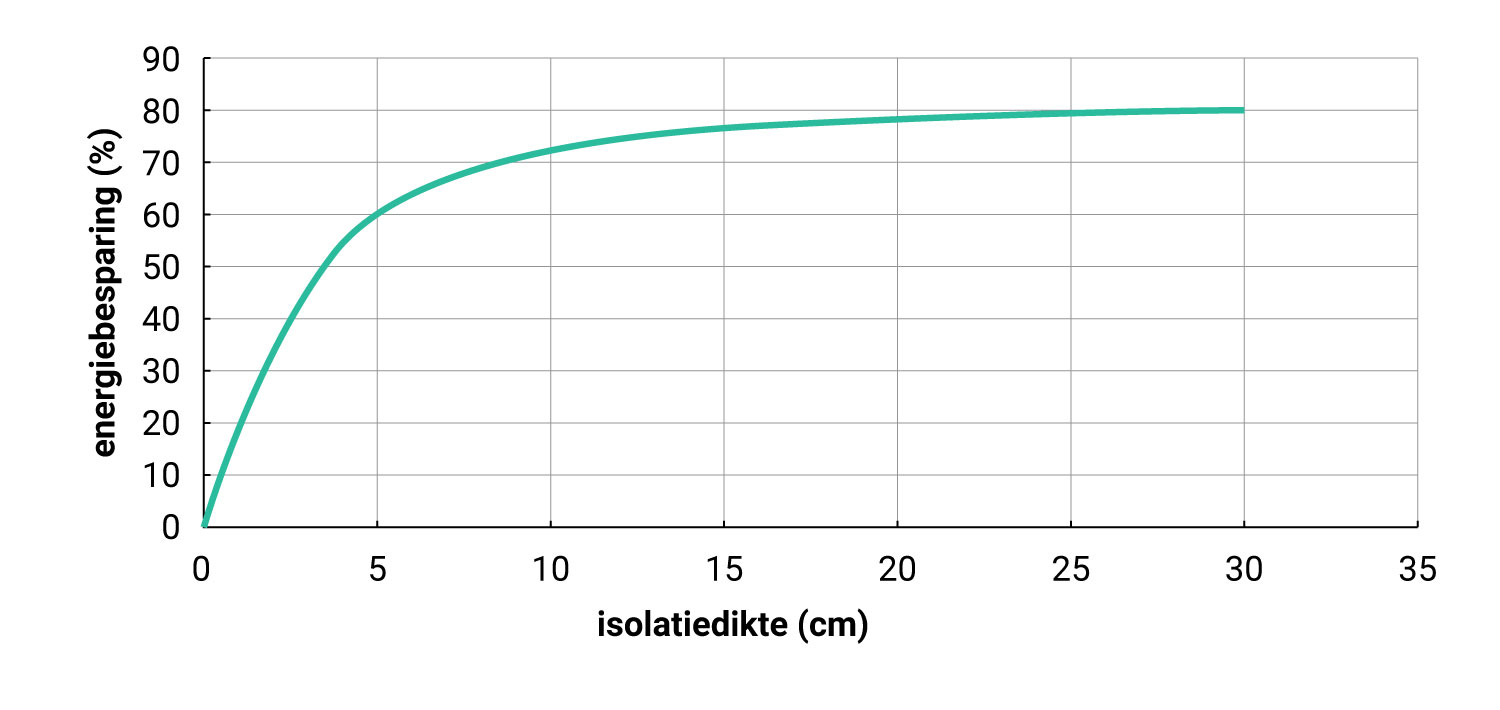
The image above shows that most energy can be saved with the first few centimetres of insulation. After that, the curve flattens, and airtightness, among other things, becomes important. Thicker insulation provides less energy saving but offers more comfort, provided it is well airtightly insulated and well ventilated.
Efficiency and savings have to do with how heat loss works in a home. In a poorly insulated home, there are often several large “leaks”, such as an uninsulated floor, facade, or roof. Once these largest losses are tackled, there is less left to improve.
You can compare it to a bucket with holes. If there are large holes, the water flows out quickly. You plug those first. If only small cracks remain afterwards, plugging them has less impact.
Practical example: roof insulation with limited savings
A project that illustrates this well is a home where we insulated the roof. The floor and facade had already been addressed, so the home was already partially improved.
The resident expected that roof insulation would still provide a clear additional saving. This is also understandable because roof insulation is often mentioned as one of the most important measures to save energy.
We insulated the roof with a vapour-open system, suitable for the existing construction, and paid extra attention to airtightness. The execution was technically sound and carefully done.
After some time, however, the resident indicated that the energy saving was around eight per cent. This felt like a disappointment, especially given the expectations outlined beforehand.
Why the savings remained limited
When you analyse the situation better, the result actually becomes logical. The largest heat losses in the home had already been tackled by the floor and facade insulation. Especially in the living room where the heating is on the highest. And a closed stairwell and a sleeping floor where there was little or no heating.
Due to the good insulation in the living room, where most of the heating takes place, less heat loss remained that could still be reduced.
In addition, the use of the home played an important role. The attic was hardly heated and did not yet function as an active living space. As a result, little heat was already lost through the roof. And if there is little heat loss, there is also less to save.
The following year, the attic floor was put into use as an office. From that moment on, there was more benefit from the good insulation because less heating was needed.
Where there was a significant gain
A major gain was especially in the fact that the attic floor remained cooler in the summer. However, we jointly noted in the first year that it could still heat up significantly to 28 °C when the sun came through the dormer window glass. We monitored the temperature with a climate monitor on the attic floor.
After the resident installed external sunscreens on the dormer window, the temperature remained 23-25 °C in the summer. That is a huge gain compared to the 38 °C indoor temperature it could reach before without roof insulation.
This example shows that insulation must always be viewed in the context of the entire home. Without that context, a skewed picture of what you can expect quickly emerges.
Airtightness: the forgotten factor in efficiency
In addition to insulation material, airtightness is one of the most important factors for the final result. Nevertheless, this is hardly mentioned in many quotes and advice.
When warm air can escape through cracks, seams, or connections, you lose energy regardless of the quality of the insulation. In practice, we regularly see situations where insulation is well installed, but the airtightness is insufficient. This ensures that the actual savings are lower than expected.
In our projects, we pay a lot of attention to airtightness. This not only affects energy consumption but also the comfort in the home.
Why it stays cooler in summer
What the resident from the example later noted was that the home remained noticeably cooler in the summer. This effect is often underestimated but is easy to explain.
Due to an airtight and well-constructed roof structure, heat cannot simply flow inwards. Instead, the heat must slowly move through the materials. This process takes time.
This smooths out temperature fluctuations and allows the heat to enter later. On warm days, this means that the peak temperature in the house remains lower and occurs later. This contributes to a more comfortable indoor climate, even without active cooling.
Common mistakes when estimating returns
There are a number of recurring reasons why the payback period of insulation in practice deviates from expectations.
Firstly, the home is often not viewed as a whole. Many pieces of advice focus on one measure, such as roof insulation or cavity wall insulation, without considering the coherence between different components.
In addition, the effect of airtightness is underestimated, while this has a major influence on energy loss. Finally, residents' behaviour often changes after insulation. A more comfortable home, for example, leads to rooms being used more often or the thermostat being set slightly higher. This can negate some of the savings.
When insulation IS profitable
Although the payback period is not always accurate, this does not mean that insulation is not a good investment. In many cases, it does provide significant benefits.
Especially in poorly insulated homes, the gain is often considerable. Also, when rooms are actively heated and the execution is carefully done, insulation can lead to a clear reduction in energy consumption.
In addition, comfort and health play an important role. Less draughts, a more stable temperature, and a more pleasant indoor climate are effects that are not always directly expressed in euros but are noticeable daily.
What to look for in an insulation quote
When comparing quotes, people often look at the price per square meter. That is understandable but gives a limited picture.
It is more important to look at what is actually being done. Is attention paid to airtightness? Is the existing construction well analysed? And is the use of the home taken into account?
These are the factors that determine whether an insulation measure actually has an effect.
For a more detailed explanation of this, you can also look at our page on what to look for in an insulation quote.
How to prevent an unprofitable investment
The best way to prevent disappointment is not to start directly with quotes but to first gain insight into your home.
Where do you lose heat?
Which measures have the most impact?
And what can you realistically expect?
By answering these questions in advance, you prevent making a decision based on an overly simple calculation.
You can learn more about this in our quiz to insulate or not to insulate.
Conclusion: insulation works, but not everywhere the same
The statement that insulation always pays for itself is attractive because it is simple. But that simplicity does not do justice to reality.
Insulation works, but the effect strongly depends on the home, the execution, and the use. Those who understand this make better choices and prevent disappointment afterwards.
Do you want to know what insulation yields in your situation?
At Isoleerbewust, we do not only look at one measure but at the home as a whole. This gives you a more realistic picture of what insulation can mean for you. In addition, you can enter your current energy consumption and energy price to calculate a more accurate payback period. But beware, it remains an approximation.
👉 Start the insulation scan
Or first read more about the different options on our pages about roof insulation and facade insulation.