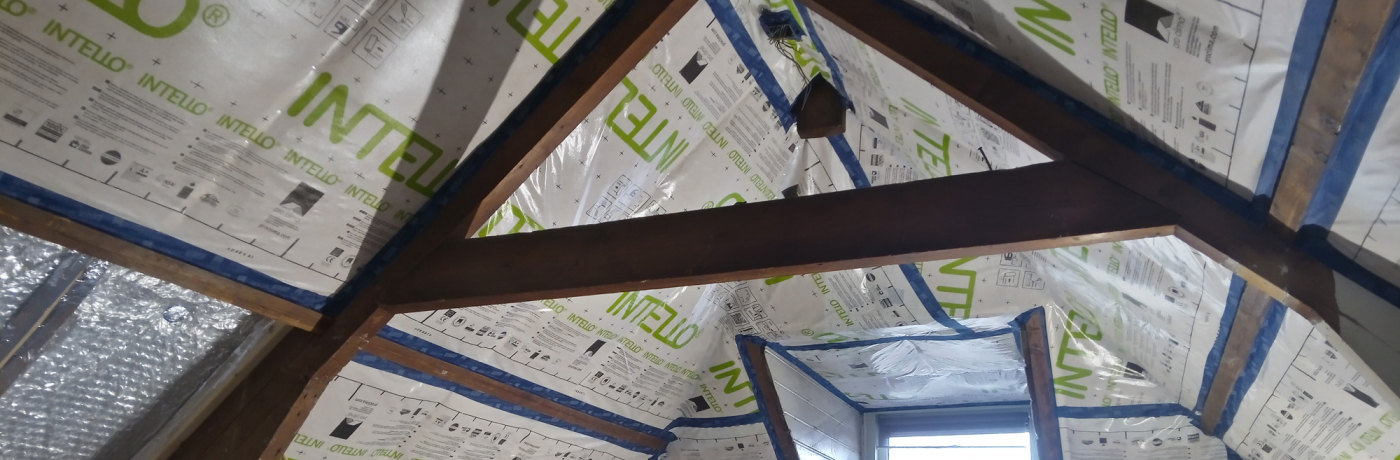
Vapour-retarding foil or vapour-barrier foil on the warm side of your insulation ensures that moist warm air does not condense within your construction, preventing mold and wood rot. The foil ensures that not all moisture produced indoors passes through your insulation. This maintains the quality and lifespan of your construction, and your insulation values do not disappear instantly.
However, on other websites, you might read that vapour-retarding foil is not necessary at all. Now you are unsure what the sensible choice is. And what about finishing with plasterboard? In this article, we tell you everything about how vapour-retarding foil works and whether you should or should not use it.
This article was originally published on April 5, 2022, and updated and republished on October 22, 2023.
Vapour-retarding foil is necessary when insulating existing facades
Let's get straight to the point: vapour-retarding foil is necessary if the facade or roof of your existing home is insulated from the inside. Vapour-retarding foil can reduce the risk of mold and rot in your construction. It retards moist warm air and prevents it from condensing against the cold facade or your roof. Additionally, it can prevent unwanted airflow through your insulation. Compare it to your undershirt. The shirt absorbs body moisture so your sweater doesn't get too wet. And if your undershirt isn't tucked into your trousers? Cold air can blow underneath. A well-tucked-in shirt prevents warm stagnant air from being blown out of your shirt and sweater.
Difference between vapour-tight foil and climate foil
A vapour-tight foil, as the name suggests, does not allow any vapour to pass through. A vapour-retarding foil blocks less vapour than a vapour-tight foil. However, a completely vapour-tight construction with foil on the warm side is difficult to achieve. A 1 mm hole can allow almost a liter of moisture into the construction per day (source: Pro Clima). Therefore, you need to tape the foil very carefully.
Climate foil is also a vapour-retarding foil with the added quality that if moisture is already in the construction, it can also return indoors on the warm side. A moisture-variable climate foil almost always works to your advantage. It is almost always the right foil for the warm side. The foil is vapour-open at low humidity and becomes more closed at high humidity.
Is vapour-retarding foil also necessary with ecological insulation materials?
Even when using ecological insulation materials
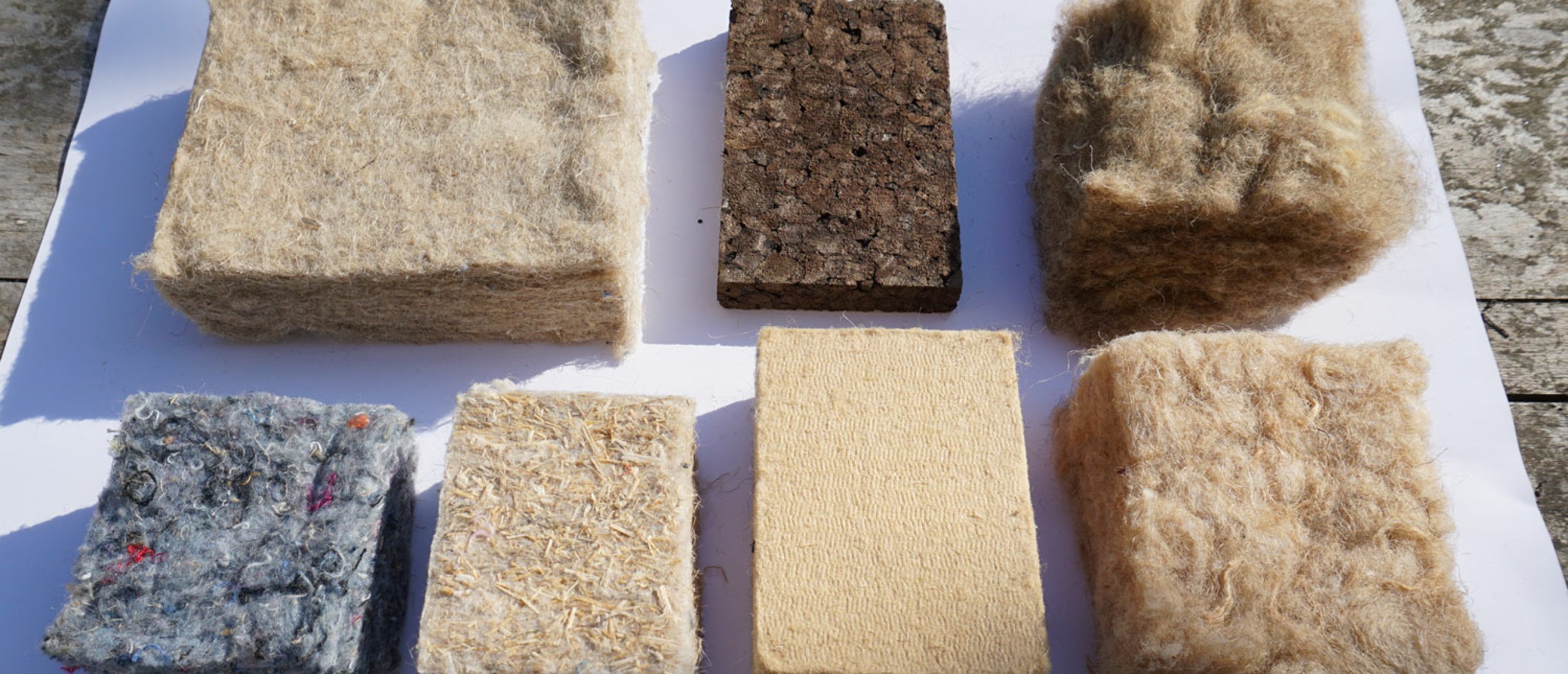
in existing buildings, vapour-retarding foil is recommended. Unless you insulate on the outside.
With vapour-retarding foil, you protect the insulation material from moisture (on the warm side) and reduce the risk of interstitial condensation. If you tape the foil properly, it also provides good airtightness. This prevents unwanted air movement through your insulation, which could halve your insulation values. A waste, therefore.
Vapour-tight foil is used on the warm side when there is concern about moisture in the construction. Most insulation materials do not cope well with moisture, such as mineral wool. The insulation value of mineralool drastically decreases when it is damp.
This is in contrast to many ecological insulation materials, which can absorb up to 30% of their own weight in moisture. But that does not mean you can omit the vapour-retarding foil in an existing home. An average family produces 20-50 liters of moisture indoors daily through washing, cooking, showering, sweating, breathing, etc. You don't want all that moisture in and through your insulation. But you do want to use the moisture-buffering capacity of ecological insulation materials. That's why you use climate foil.
In ecological construction and retrofit insulation, vapour-proof foil is never used. Except on the cold side of a flat roof in the form of EPDM.
Prevent 'air pockets' in your construction
The fibers in ecological insulation materials are designed to store and transport moisture. Just like the tree, plant, or hair from which they are made. These are also called hygroscopic insulation materials. To prevent condensation, mold, and wood rot, you must ensure that no 'air pockets' form on the cold side. Otherwise, vapor has room to 'hang' as a droplet. If everything is well filled with ecological insulation material and condensation occurs, the fibers can reabsorb and transport the moisture.
And when do you use vapour-open foil?
Vapour-open foil is used in existing buildings on the cold side of insulation. Your construction must become increasingly vapour-open from inside to outside so that indoor moisture can escape. The vapour-open foil also serves as a wind and rain barrier. Compare it to a breathable rain jacket or Gore-Tex fabric.
The wind and rain barrier on the cold side must be more vapour-open than the airtight and vapour-retarding layer on the warm side, allowing moisture produced indoors to escape. Vapour-open foil is the foil found under roof tiles.
Can you also use board material as a vapour-retarding layer?
The short answer is yes. The long answer is: it depends on where you apply it. In existing buildings, you can only do this when insulating an internal wall, for example, between you and your neighbors. Assuming it doesn't get colder than 15 degrees Celsius on either side too often.
Furthermore, board material is used as a vapour-retarding layer in new construction. Especially in timber frame construction where no bricks or concrete are used in the facade.
Semi-rigid wood fiberboards or sturdy OSB boards, among others, can serve as an airtight and vapour-retarding layer on the inside of the construction. If you then apply clay plaster, for example, on the wood fiberboards and ensure it fits well in the corners, this is sufficiently airtight. If you want to be sure of the airtightness, you can tape the seams and corners with specific airtight adhesive tape, such as Pro Clima's uni tape. This is often done with OSB boards.
Pay attention to any penetrations. Here, it is advisable to take extra measures for airtightness and vapor retardation. For example, you have airtight wall sockets.
Using foil ensures that the airtight and vapour-retarding layer is further back in the construction. Penetrations of, for example, wood fiber, do not immediately compromise the airtight layer. In general, the airtightness will therefore continue to function longer, even with future use involving potential penetrations.
Should you also use vapour-retarding foil with plasterboards?
Plasterboards are generally vapour-open. In existing buildings, plasterboards allow too much moisture through. The risk of warm, moist air condensing against the cold facade or cold underlayment is too great. Therefore, use vapour-retarding foil if you want to apply plasterboards. Incidentally, painting with latex paint makes the construction largely vapour-tight on the warm side again. If moisture can then enter the construction, it can become trapped.
How do you apply vapour-retarding foil?
Do not attach the foil to the construction, and tape it all around and at the overlap